Who Is the Greatest Basketball Player of All Time? 5 Million Simulations Answer
Ask ten basketball fans who the greatest player of all time is and you will get at least three answers. Most of the time the argument is not really about the players. It is about what each person values: championships, raw numbers, longevity, defense, or that feeling of watching someone you knew could not be stopped.
So instead of picking one answer, we tested all of them. We scored 50 legends on 9 criteria, then ran 5 million random weightings of those criteria to see who comes out on top, and how often.
The short answer
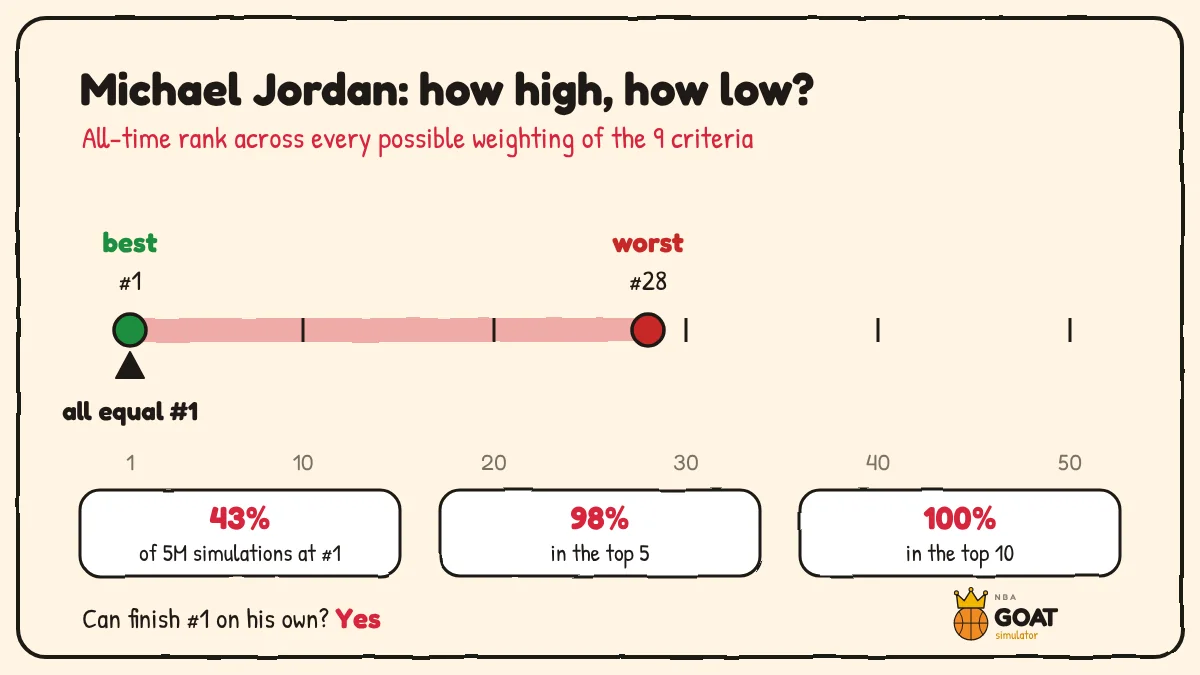
Michael Jordan is the most likely answer. He finishes first in 43.0% of the 5 million simulations. But he is far from the only one:
| Player | Share of simulations at #1 |
|---|---|
| Michael Jordan | 43.0% |
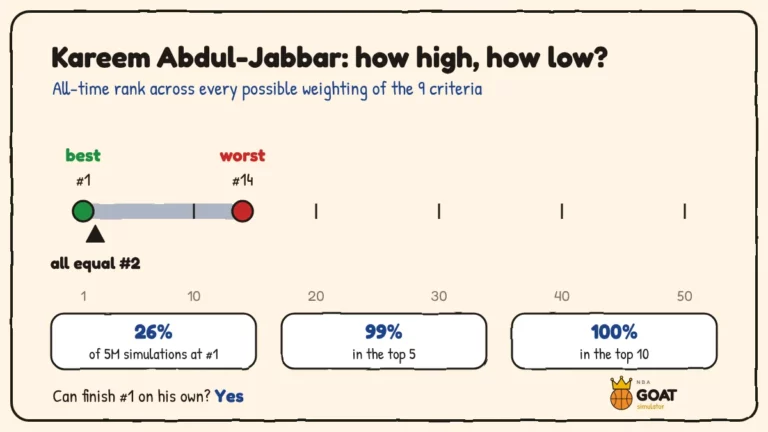
| Kareem Abdul-Jabbar | 26.2% |
| LeBron James | 15.8% |
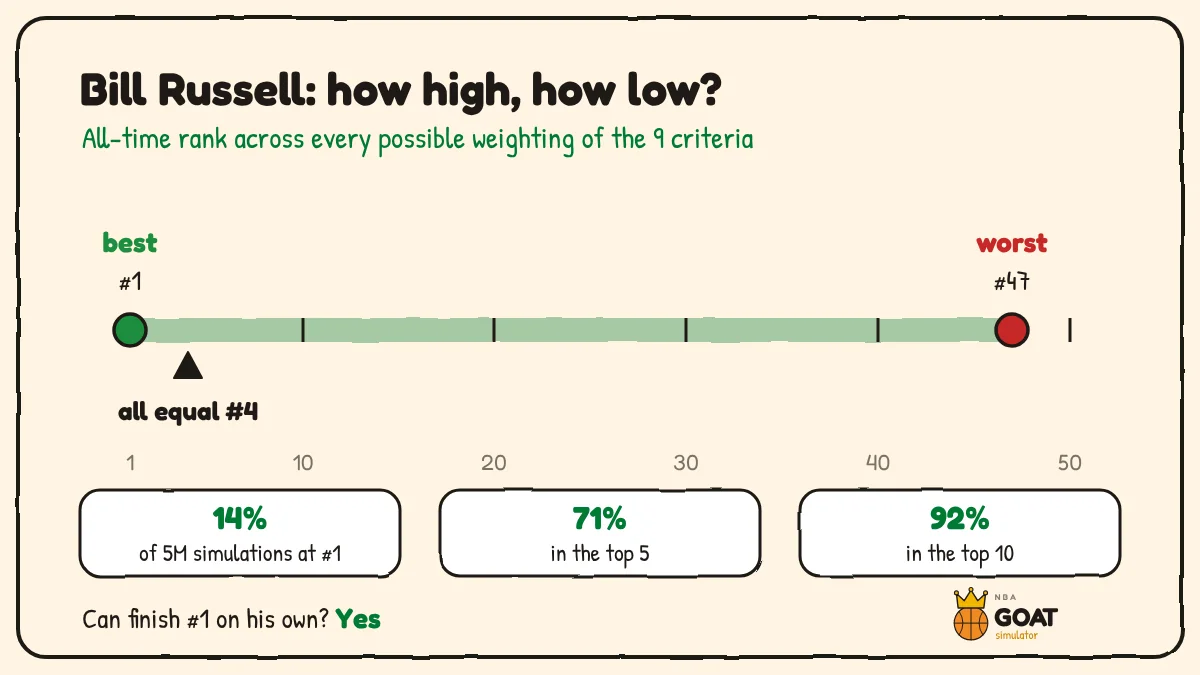
| Bill Russell | 14.4% |
| Tim Duncan | 0.55% |
| Everyone else combined | less than 0.05% |
Four players take 99.4% of all the #1 spots. If you are arguing for someone outside that group, the math says you are fighting uphill.
How we measured greatness
Every player in the NBA GOAT Simulator is scored out of 50 on nine criteria:
- Rings: championships won, with the first ones worth more than the last ones.
- Awards: MVPs, Finals MVPs, All-NBA selections and other individual honors.
- Stats: career production, regular season and playoffs.
- Playoffs: how a player performed when it mattered most.
- Longevity: how long he stayed at an elite level.
- Defense: individual defensive impact.
- Culture: influence on the game and beyond it.
- Win %: how much his teams won.
- Peak: how dominant he was at his very best.
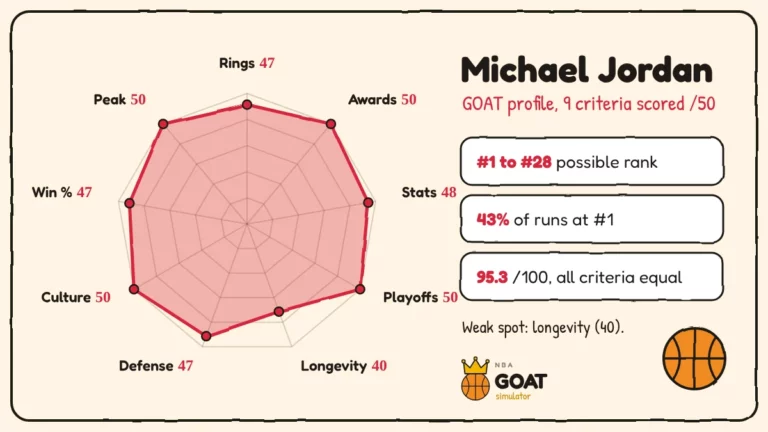
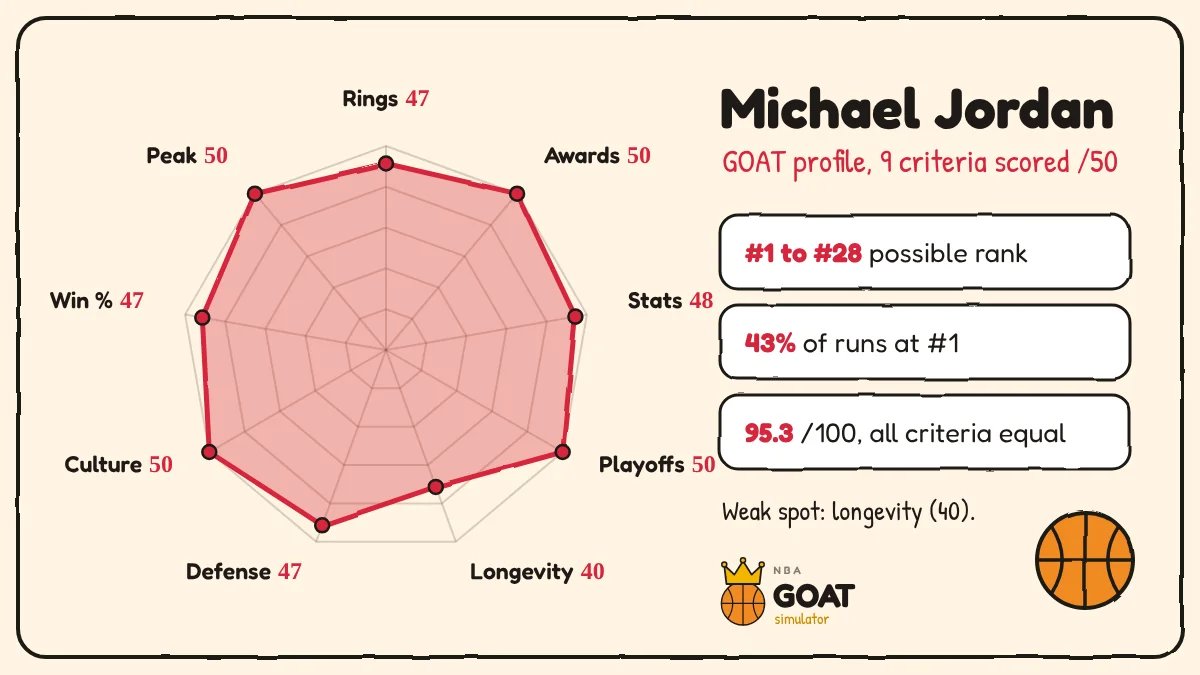
With every slider at the same weight, the top of the ranking looks like this: Jordan 95.3, Kareem 95.1, LeBron 94.4, Russell 92.9 and Duncan 91.8. The gap between first and second is just 0.22 points.
Then we changed the weights. 5 million times, at random. Each run is one possible fan: someone who cares a lot about rings and not much about stats, someone who only trusts peak dominance, someone who rewards longevity above all. The result is not a single ranking but a map of every reasonable opinion.
Why Jordan wins most often
Jordan has four perfect scores (awards, playoffs, culture and peak) and nothing lower than 40. His only soft spot is longevity, because he played 15 seasons with two retirements in the middle. Unless you make longevity the most important thing in your ranking, he is very hard to pass.
His 6-0 record in the NBA Finals, with six Finals MVPs, is the kind of résumé that holds up under almost any weighting. That is exactly what the simulations show: he is #1 in 43% of them and in the top 5 in about 98%.
Kareem, the GOAT people forget
Kareem Abdul-Jabbar is the most underrated name in this debate. He holds the record for MVPs (6), won 6 rings, played 20 seasons and was the NBA’s all-time leading scorer for almost 39 years. In our model he has perfect scores in awards, stats and longevity.
He is also the most stable player of all. Whatever weights you choose, Kareem never falls below 14th. No other player in the top 50 can say that. When fans value longevity and statistics, Kareem takes the crown.
LeBron, the longevity king
LeBron James scores 50/50 in stats, longevity and culture. He is the first player to reach 40,000 career points, with 4 rings and 4 Finals MVPs. His case gets stronger every time someone puts more weight on a long career at the very top.
What holds him back is rings (41/50) and defense (41/50) compared to Jordan, Kareem and Russell. If you remove rings from the equation entirely, LeBron becomes the #1 player in our neutral ranking.
Bill Russell, the most extreme case
Bill Russell won 11 titles in 13 seasons. He scores 50/50 in rings, playoffs, defense and win percentage. When winning is all that matters, nobody comes close.
But his stats score (36/50) makes him the most unstable player in the debate. Depending on the weights, he can finish anywhere from 1st to 47th. He is the perfect example of why the GOAT question has no single answer.
Who can never be the GOAT?
Here is the surprising part. Out of 50 legends, only 9 players can finish #1 on their own with some combination of weights: Jordan, Kareem, LeBron, Russell, Duncan, Wilt Chamberlain, Hakeem Olajuwon, Magic Johnson and Kobe Bryant. Curry, Garnett and Stockton can only share first place, never hold it alone.
Everyone else is mathematically blocked. Larry Bird, for example, can never finish higher than 5th, because Jordan and LeBron are better than him or equal to him on every single criterion.
So who is the greatest basketball player of all time?
If you want one name, it is Michael Jordan. He wins more scenarios than anyone, and he wins them with room to spare.
But the honest answer is that the GOAT depends on what you value. Value rings above all and you get Russell. Value longevity and you get Kareem or LeBron. Value peak dominance and you get Jordan. The best way to settle your own debate is to set the weights yourself.
Try the NBA GOAT Simulator and see who your values crown.
FAQ
Who is considered the greatest basketball player of all time?
Michael Jordan is the most common answer, and our model agrees: he finishes first in 43.0% of 5 million weighting scenarios. Kareem Abdul-Jabbar, LeBron James and Bill Russell are the other realistic candidates.
Is LeBron better than Jordan?
Jordan finishes ahead of LeBron in about two thirds of our simulations. LeBron wins when longevity and career stats carry the most weight, or when rings are removed from the equation.
How many players can be the GOAT?
Only 9 of the 50 players in our model can finish #1 on their own under some combination of weights. Four of them (Jordan, Kareem, LeBron and Russell) account for 99.4% of all #1 finishes.
What data is the ranking based on?
Each player is scored on 9 criteria out of 50. Careers of active players are counted through the 2024-25 season.